
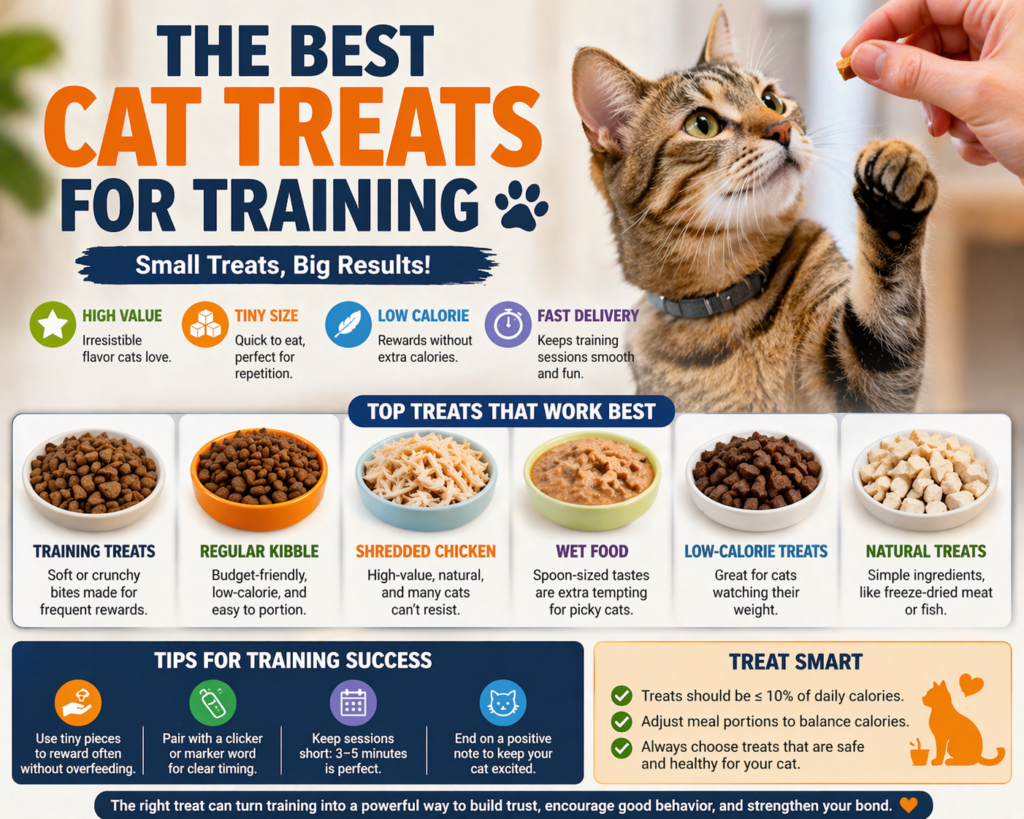
Best Cat Treats for Training: What Actually Works for Clicker Training and Good Behavior
Finding the best cat treats for training is not as simple as buying the most expensive bag at the pet store. A good training treat has a job to do. It must be motivating enough to hold your cat’s attention, small enough to be eaten quickly, and sensible enough that repeated rewards do not overload your cat with unnecessary calories. That balance matters because cat training works best when the reward is immediate, consistent, and easy to repeat over many short sessions. Blue Cross explains that clicker training is built on rewarding the right behavior so the animal wants to repeat it, while VCA advises choosing treats that are easy to break into many small pieces, small kibble, or other low-calorie options for training.
That is why the best cat treats for training are not always the fanciest treats on the shelf. In practice, the most effective options usually share the same features: they are tiny, high-value, fast to chew, and convenient to deliver the moment your cat performs the behavior you want. Cats Protection notes that clicker training depends on pairing the click with an immediate reward, and Blue Cross says the click should reliably mean a treat is coming. That timing is easier when the reward is small and ready to hand over instantly.
A lot of weak SEO articles make the mistake of listing random treat brands without explaining why some treats help training and others slow it down. If you want a page that ranks and converts, you need to answer the actual commercial question behind the query: what are the best cat treats for training, and what makes them better than ordinary treats? The answer is that the best rewards are highly motivating but controlled in size and calories. VCA’s nutrition guidance says treats should generally make up no more than 10% of a cat’s daily calorie intake, and it specifically recommends low-calorie treats or regular food portions for many cats.
Why treat choice matters in cat training
Cats do not usually respond well to long, repetitive training sessions. Cats Protection recommends keeping training sessions short, around five minutes, to avoid frustration and help cats succeed. That means every reward needs to work quickly. If the treat is too large, messy, or slow to eat, the flow of training breaks down. If the treat is too bland, your cat may simply lose interest. The best cat treats for training therefore help preserve momentum. They allow quick reward delivery, repeated reinforcement, and a clean link between behavior and payoff.
Clicker training makes this even clearer. Cats Protection explains that clicker training uses a consistent sound as a marker, followed by a treat, so the cat learns exactly which action earned the reward. Blue Cross adds that a clicker is often clearer than a voice because it is quick and consistent. That means the treat must follow immediately and should not create delay. In other words, the best cat treats for training are not only tasty. They are operationally useful.
What makes the best cat treats for training?
The best cat treats for training usually have five qualities.
First, they are small. VCA explicitly recommends treats that can be broken into many small pieces or small kibble for training work. Tiny rewards let you reinforce behavior many times without overfeeding.
Second, they are high value. Blue Cross suggests using foods cats find especially rewarding, such as bits of shredded chicken or a little wet food on a teaspoon. A treat only works if your cat cares about it.
Third, they are low enough in calories to be used repeatedly. VCA states that treats should stay within about 10% of the cat’s daily calories, which means training treats must be budgeted carefully, especially for indoor or lower-activity cats.
Fourth, they are easy to deliver fast. The reward should come immediately after the desired behavior, not after fumbling with a large chew or opening a packet. Cats Protection emphasizes that the treat should follow the click straight away.
Fifth, they are safe for the individual cat. VCA notes that cats with medical conditions, food allergies, kidney disease, heart disease, or prescription diets may need special treat choices approved by a veterinarian.
Best cat treats for training: the top options
1. Tiny commercial training treats
For most owners, the easiest answer to best cat treats for training is a soft or crunchy commercial cat treat that can be given in tiny pieces. These work well because they are convenient, portable, and usually very motivating. The best ones are the ones you can break down easily or feed one tiny piece at a time. VCA’s guidance supports this directly by recommending treats that break into many small pieces or other low-calorie options.
2. Pieces of regular kibble
This is one of the most underrated answers to the best cat treats for training question. VCA recommends trying a portion of the cat’s regular food as treats, especially for food-motivated cats. This is practical, inexpensive, and useful for calorie control. It also helps owners who want to train frequently without relying too heavily on extra treats.
3. Shredded chicken
If your cat is selective, bits of shredded chicken are often one of the best cat treats for training because they are highly appealing and easy to portion. Blue Cross specifically mentions shredded chicken as an option for cat clicker training. This makes chicken a strong fit for owners asking about the best cat treats for clicker training.
4. Wet food on a spoon or teaspoon
For some cats, wet food is more motivating than dry treats. Blue Cross notes that a piece of wet food on a teaspoon can be used for cats in clicker training. This option is especially useful for cats that swallow crunchy treats too slowly or show stronger interest in moist food textures. It is also a smart choice when you want very small licks rather than repeated larger bites.
5. Low-calorie veterinary-approved treats
If weight management is a concern, low-calorie treats may be the best cat treats for training because they allow more repetitions while staying within a reasonable calorie budget. VCA recommends choosing low-calorie treats and checking labels rather than assuming “light” branding automatically means substantially fewer calories.
Best cat treats for clicker training
The keyword set includes “best cat treats for clicker training,” and this deserves its own section inside the article rather than a separate thin page. Clicker training depends on precision. Blue Cross says the click must be followed by a guaranteed reward, and Cats Protection explains that the treat should come immediately after the click so the cat links the behavior with the reward. That means the best cat treats for training in clicker work are usually tiny, soft, fast, and easy to repeat many times.
For clicker training, the strongest options are usually shredded chicken, tiny commercial treats, pea-sized low-calorie treats, or a little wet food delivered quickly. Large chews and slow-to-eat snacks are weaker choices because they interrupt the rhythm of training. In SEO terms, this section lets the article rank for “best cat treats for clicker training” and “best treats for clicker training cats” without creating duplicate content.
Best natural treats for cat training
Another intent in your list is “best natural treats for cat training.” That fits naturally here. Many owners use “natural” to mean simpler, minimally processed rewards such as plain cooked chicken or veterinarian-approved single-ingredient options. The important point is that natural does not automatically mean better. The best cat treats for training are still the treats that are tiny, motivating, calorie-aware, and suitable for your cat’s health needs. VCA warns that some foods can be too high in calories and that cats with medical conditions may need stricter treat choices.
So, yes, natural treats can be excellent training rewards. But they still have to meet the same standard as any other training treat: easy to portion, quick to feed, and used in moderation.
How many treats should you use in training?
This is where owners often make mistakes. They focus so much on finding the best cat treats for training that they forget quantity matters as much as quality. VCA’s guidance is clear that treats should generally stay within 10% of a cat’s daily calorie intake, with the remaining 90% coming from complete and balanced food. VCA also recommends creating a “treat budget” once you know your cat’s daily calorie needs.
That matters because cat training often involves many repetitions. A five-minute training session may include numerous rewards, especially during early learning. Cats Protection recommends keeping sessions short, which helps, but owners still need to use tiny rewards and reduce meal portions if needed.
What to avoid when choosing the best cat treats for training
Some treats are poor training tools even if cats like them. Very large treats slow down repetition. Messy foods can make timing harder. High-calorie treats may make short sessions surprisingly expensive in nutritional terms. VCA specifically warns that some highly palatable foods can be very calorie-dense and should be used cautiously. It also advises caution with some freeze-dried or dehydrated raw treats because of bacterial contamination risks.
Another mistake is using rewards inconsistently. Blue Cross says the golden rule of clicker training is that every click should be followed by a treat. If the treat is delayed or skipped too often, the meaning of the click weakens. That is another reason the best cat treats for training are the ones you can deliver instantly and repeatedly.
Best cat treats for rewarding good behavior
Your keyword list also includes “best cat treats for training and rewarding good behavior.” That is important because treat use is not limited to tricks. The same principles apply when reinforcing calm carrier entry, target training, recall, or cooperative handling. VCA notes that treats can be used to reinforce behaviors and teach new things, while Cats Protection frames positive reinforcement training as a useful way to build confidence and bond with your cat.
So the best cat treats for training are also the best treats for rewarding everyday good behavior: sitting calmly, entering the carrier, touching a target, staying relaxed during handling, or responding to their name. In commercial SEO terms, that broadens the page’s usefulness and supports more secondary keywords.
Final verdict
The best cat treats for training are not defined by branding alone. They are defined by function. The best ones are small, high-value, easy to feed immediately, and controlled enough in calories to support repeated training without undermining your cat’s diet. Vet-backed guidance points to small broken-up treats, kibble, low-calorie rewards, shredded chicken, and small amounts of wet food as practical choices, while welfare groups consistently support short, positive, reward-based sessions for cats.
If you want the shortest practical answer, it is this: the best cat treats for training are the treats your cat loves enough to work for, but small enough that you can use many times in a short, positive session. That is what makes a reward useful in real training, not just attractive on a label.