
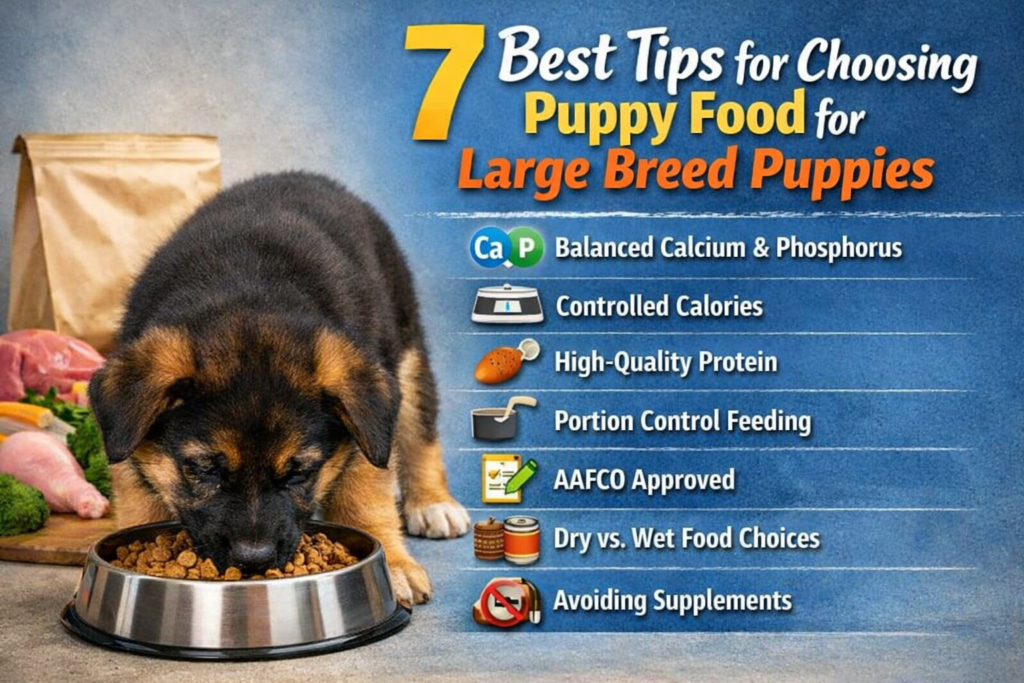
Best Puppy Food for Large Breed Puppies: Complete Guide
Choosing the best puppy food for large breed puppies is one of the most important decisions you can make for your dog’s long-term health. Large breed puppies do not just need “more food” because they will become bigger dogs. They need nutrition that supports steady growth, proper bone development, balanced mineral intake, and a healthy body condition during a much longer growth period than smaller breeds. AAFCO’s model regulations identify large-size dogs as those expected to weigh 70 pounds or more as adults, and Merck notes that large- and giant-breed puppies need diets specifically formulated for that growth stage.
Many owners assume the best puppy food for large breed puppies is the richest or most calorie-dense option on the shelf. In reality, the opposite problem is more common: feeding too much energy or too much calcium too early can encourage overly rapid growth, which can increase the risk of skeletal and joint problems. AKC explains that large-breed puppies are especially vulnerable to diet-related developmental orthopedic disease when mineral intake and calories are not well controlled, while Merck warns that overfeeding during growth is undesirable because it increases growth rate and can interfere with proper skeletal development.
That is why the best food for large breed puppies is not chosen by marketing words like “premium,” “natural,” or “high performance.” The best choice is a food that is complete and balanced, specifically appropriate for large-breed growth, and easy to feed in measured portions. AAFCO and WSAVA both emphasize that owners should look beyond front-of-bag claims and focus on the nutritional adequacy statement, calorie information, and overall formulation quality.
Why large breed puppies need special food
Large breed puppies grow very differently from small and medium breeds. AKC notes that giant-breed puppies can end up more than 100 times their birth weight, and that this very fast, very large growth creates unique nutritional needs. Unlike adult dogs, large breed puppies must build bones, joints, muscles, and connective tissue at the same time, so the diet has to support growth without pushing the puppy to grow too fast.
One of the biggest reasons owners search for the best puppy food for large breed puppies is calcium. Calcium is essential for bone development, but AKC explains that too much calcium can be just as harmful as too little, because the excess may be deposited into bone tissue in ways that contribute to skeletal abnormalities. AAFCO’s nutrient guidance reflects this by setting specific calcium and phosphorus requirements and maximums for foods intended for the growth of large-size dogs.
Calories are just as important. If a large breed puppy consumes too many calories, it may gain weight too quickly and put extra stress on developing joints. AKC notes that limiting calories helps slow growth rates and reduces the risk of developmental orthopedic disease, while WSAVA advises that large-breed growing puppies should be fed in a portion-controlled manner to maintain a slow rate of weight gain and a healthy body condition score.
What to look for in the best puppy food for large breed puppies
The first thing to check when shopping for the best puppy food for large breed puppies is the AAFCO nutritional adequacy statement. This is one of the most important parts of the label because it tells you whether the food is formulated for growth and, crucially, whether it is appropriate for large size dogs (70 lb. or more as an adult). AAFCO’s model language even allows a label to say a product is complete and balanced for growth except for growth of large size dogs if it does not meet the required nutrient levels for that category.
The second thing to look for is controlled calcium and phosphorus. The best large breed puppy food should not just contain these minerals; it should contain them in the right amounts and ratios. AAFCO’s nutrient profile work includes a calcium-to-phosphorus balance and separate large-size growth considerations specifically because mineral control matters so much during this stage. This is one of the clearest technical differences between ordinary puppy food and true large breed puppy food.
The third thing to consider is calorie density. The best puppy food for large breed puppies should support lean, steady growth rather than making the puppy bulk up quickly. AKC recommends feeding a diet that supports controlled growth, not maximum growth speed, and WSAVA’s guidance supports portion control rather than free-feeding for this reason.
The fourth thing is brand transparency. WSAVA’s pet food selection guidance recommends asking whether the company employs a qualified nutritionist, whether it has proper quality-control processes, and whether it can provide detailed nutrient information. These questions are far more useful than relying on marketing phrases. If you want to choose the best puppy food for large breed dogs, this is one of the smartest filters you can use.
What to avoid when feeding large breed puppies
A major mistake is overfeeding. Merck explicitly states that overfeeding during growth increases growth rate and is undesirable because it can interfere with proper skeletal development. This means the best puppy food for large breed puppies can still be the wrong choice if the portions are too large. Even an excellent food can become a problem when it is fed without measurement or when owners interpret a chunky puppy as a healthy puppy.
Another common mistake is adding calcium or bone-growth supplements to a complete puppy food. Many owners think this will strengthen bones, but Merck says that supplementing calcium, phosphorus, or vitamin D beyond what is already in a complete and balanced growth diet is rarely necessary and may even be contraindicated. AKC also cautions owners not to add supplements for large-breed puppies unless directed by a veterinarian.
A third mistake is assuming all puppy foods are interchangeable. They are not. AAFCO’s label wording makes that clear because some foods are complete and balanced for puppy growth in general but not for the growth of large-size dogs. If you are serious about finding the best puppy food for large breed puppies, you must read the label carefully rather than assuming every food labelled “puppy” is suitable.
Best dry puppy food for large breed puppies vs wet food
Many owners specifically search for the best dry puppy food for large breed puppies. Dry food is popular because it is easy to store, easy to measure, and practical for scheduled feeding. Merck notes that commercial dog foods come in canned, dry, and semimoist forms, and that complete and balanced commercial diets are designed to provide adequate nutrients without intolerable excesses. So the key issue is not whether the food is dry or wet, but whether it is properly formulated for large-breed growth.
That said, dry food can be especially convenient for large breed puppies because portion control is so important. Owners can usually measure kibble more consistently and adjust amounts as the puppy grows. This is an inference from Merck’s scheduled feeding guidance and WSAVA’s recommendation against free-feeding large-breed puppies. Wet food can also work, but the best puppy kibble for large breed puppies is often preferred in day-to-day feeding because it makes measured feeding simpler.
Feeding schedule for large breed puppies
A strong article on the best puppy food for large breed puppies should also address feeding schedule, because food quality and feeding routine work together. Merck recommends that puppies between weaning and 6 months are generally fed three times a day, while puppies 6–12 months are often fed twice daily. Merck’s puppy care guidance also describes a pattern of four meals daily at 6–12 weeks, three meals daily at 3–6 months, and two meals daily at 6–12 months.
The key point is that large breed puppies should not have unlimited food available all day. WSAVA specifically says free-feeding should not be used for large-breed growing puppies because they need a slow rate of weight gain and careful body condition management. So when people ask what to feed large breed puppies, the answer is not just about the product — it is also about feeding the right amount on the right schedule.
Puppy food for large breed puppies with sensitive stomachs
Some owners need the best puppy food for large breed puppies with sensitive stomachs. In those cases, digestive comfort matters, but the large-breed growth requirements still come first. The food should still be complete and balanced and still be clearly suitable for large-size growth. WSAVA’s global nutrition guidance emphasizes an individually tailored nutrition plan, which is especially important when a puppy has digestive upset, poor appetite, or inconsistent stools.
If a large breed puppy has persistent diarrhoea, vomiting, poor growth, or trouble maintaining a healthy body condition, that is not just a food-shopping issue. It is a veterinary issue. The safest approach is to choose a properly formulated large-breed puppy food, transition slowly, and involve a veterinarian if symptoms continue. That conclusion follows from WSAVA’s tailored nutrition principles and Merck’s emphasis on complete and balanced diets for specific life stages.
Final thoughts
The best puppy food for large breed puppies is not the food that promises the biggest muscles or the fastest growth. It is the food that supports controlled growth, balanced minerals, healthy joints, and a lean body condition across the puppy’s long development period. AAFCO, AKC, Merck, and WSAVA all point in the same direction: choose a food that is complete and balanced for large-breed growth, monitor portions carefully, avoid unnecessary supplements, and do not encourage rapid weight gain.
If you want the simplest possible takeaway, the best puppy food for large breed puppies will have the correct AAFCO growth statement for large-size dogs, sensible calcium and phosphorus control, manageable calorie density, and a feeding routine that keeps your puppy growing steadily rather than quickly. That is the right answer for both SEO and real-world puppy care.
FAQs
What is the best puppy food for large breed puppies?
The best option is a complete and balanced diet specifically appropriate for the growth of large size dogs (70 lb. or more as adults), with controlled minerals and calories that support steady growth.
Do large breed puppies need special puppy food?
Yes. Large breed puppies have different calcium, phosphorus, and calorie needs than smaller breeds, and AAFCO and Merck both distinguish large-breed growth diets from general puppy foods.
Should I add calcium supplements to large breed puppy food?
Usually no. Merck says calcium, phosphorus, or vitamin D supplementation beyond a complete and balanced growth diet is rarely necessary and may be inappropriate.
Is dry food better for large breed puppies?
Dry food is often easier to portion and store, but the most important factor is that the food is complete and balanced for large-breed growth. Both dry and wet can work if properly formulated.
How often should large breed puppies be fed?
Merck recommends multiple meals when young, commonly three meals daily up to about 6 months and two meals daily from 6–12 months, adjusted to the individual puppy.